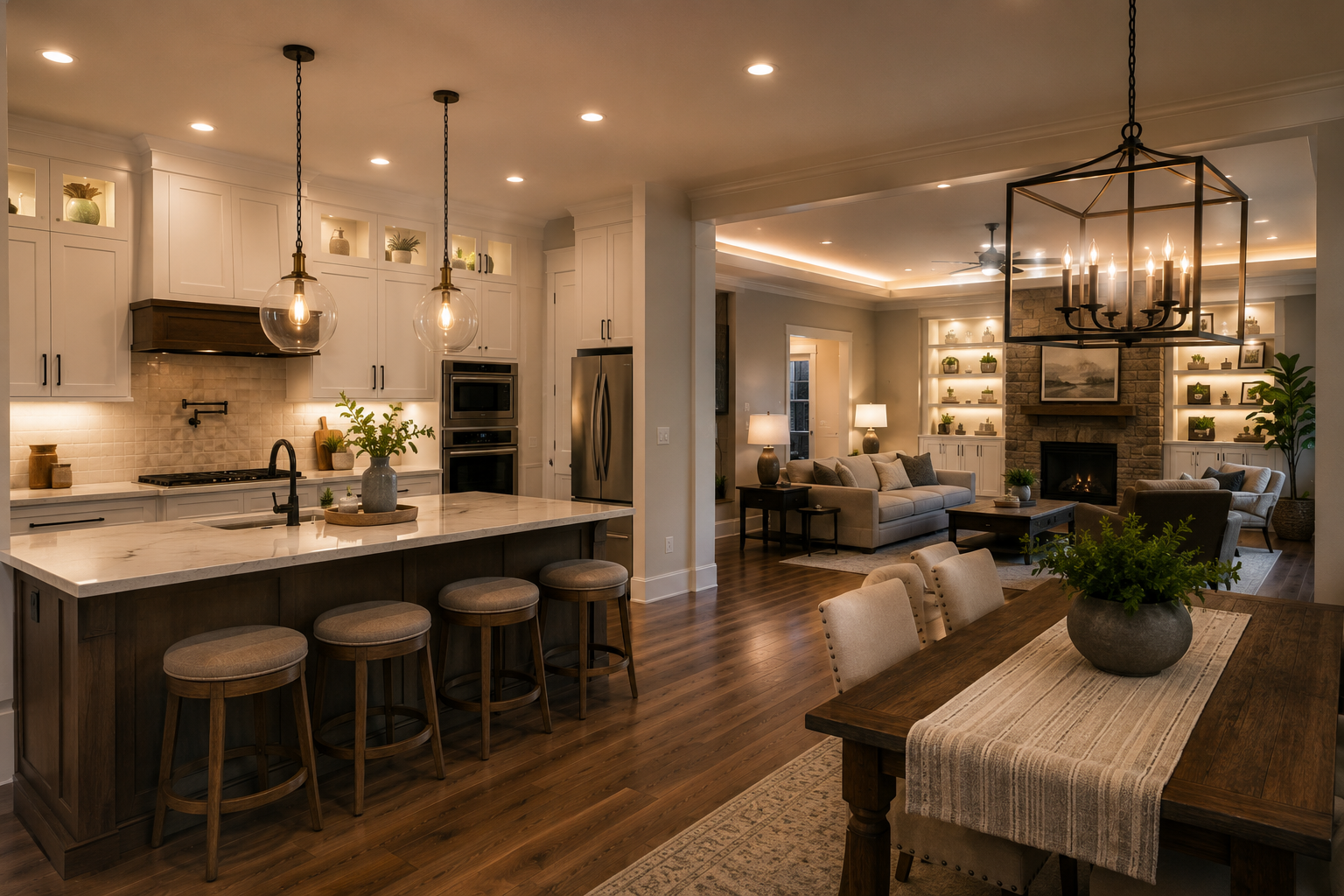
Expert Tips on Creating Lighting That Works as Hard as It Looks
Lighting is one of the most overlooked aspects of home renovation. Homeowners focus heavily on cabinets, countertops, flooring, and paint colors — but they often give lighting an afterthought.
This is a critical mistake.
The right lighting transforms a space. It affects how the room functions, how it feels, and how it makes you feel emotionally. Poor lighting makes a beautiful room feel disappointing. Great lighting makes an ordinary room feel special.
Yet many homeowners discover too late that their new kitchen looks beautiful but is poorly lit for cooking. Or their new bathroom has harsh shadows around the vanity. Or their dining room lighting doesn’t create the ambiance they imagined.
At All-Pro Renovations, we’ve designed and installed lighting for thousands of Kansas City home renovations. We know how to create lighting that’s both functional and beautiful. We understand the three layers of lighting that make spaces work. We know how to avoid common lighting mistakes that compromise your renovation investment.
In this comprehensive guide, we’ll walk you through everything you need to know about lighting design — so your renovated spaces look and function exactly as you envision.
🎯 Understanding the Three Layers of Lighting
The foundation of professional lighting design is understanding that every well-lit space combines three distinct layers:
Layer 1: Ambient Lighting (General Illumination)
This is the base layer — the overall light that fills the entire room.
Purpose: Provide general visibility and set the tone for the space
Typical sources:
- Ceiling-mounted fixtures
- Recessed lighting
- Flush-mount fixtures
- Chandeliers (in some rooms)
- Pendant lights used in multiples
Brightness level: Moderate brightness that fills the space without being harsh
Importance: Without adequate ambient light, a room feels dark and cave-like, no matter how good the other layers are.
Common mistake: Using only one ceiling fixture in a large room, creating uneven lighting with dark corners
Layer 2: Task Lighting (Functional Light for Activity)
This layer provides focused light where you actually do activities.
Purpose: Illuminate specific work areas so you can see clearly and safely
Typical sources:
- Vanity lights flanking bathroom mirrors
- Under-cabinet lighting in kitchens
- Desk lamps in home offices
- Pendant lights over kitchen islands
- Reading lights in bedrooms
- Focused recessed lights over work areas
Brightness level: Brighter than ambient; focused on the work area
Importance: Without task lighting, you struggle to see what you’re doing. You hold your face uncomfortably close to mirrors. You squint while cooking. Task lighting is essential for functionality.
Common mistake: Placing task lighting in positions that create shadows on the work surface (like overhead light directly above your head while standing at the sink)
Layer 3: Accent Lighting (Design and Ambiance)
This is the design layer — light that highlights architectural features, creates mood, and adds visual interest.
Purpose: Make the space feel intentional and create atmosphere
Typical sources:
- Niche lighting inside architectural features
- Under-cabinet lighting (can serve both task and accent purposes)
- Wall-wash lighting on feature walls
- Lighting inside glass cabinets
- Spotlights on artwork
- Backlighting behind floating shelves
- Toe-kick lighting
Brightness level: Lower brightness; creates mood rather than functionality
Importance: Accent lighting transforms a functional space into a designed space. It makes the difference between a room that works and a room you love.
Common mistake: Skipping accent lighting as a cost-saving measure, resulting in a functional but uninspired room
💡 Lighting Fundamentals Everyone Should Know
Before diving into room-specific recommendations, understand these lighting principles that apply everywhere.
Color Temperature: Warm vs. Daylight
Light has different “colors” (though we don’t perceive them as colors). These are measured in Kelvin (K):
2700K (Warm White)
- Soft, warm appearance
- Creates relaxing, intimate atmosphere
- Best for bedrooms, living rooms, dining rooms
- Less ideal for task areas where color accuracy matters
- Creates a cozy feeling but can feel dim in work areas
3000K (Warm-to-Neutral)
- Slightly less warm than 2700K
- Good compromise between ambiance and visibility
- Works well in kitchens and bathrooms where both function and comfort matter
- Becoming increasingly popular in home renovation
4000K (Cool White/Daylight)
- Neutral, clear appearance
- Most like natural daylight
- Best for task lighting and work areas
- Makes colors appear true to life
- Can feel harsh in relaxation spaces if used alone
5000K+ (Daylight)
- Bright, energetic appearance
- Best for situations where color accuracy is critical
- Less common in home renovation; more common in commercial/medical spaces
- Can feel too clinical for home environments
Best practice: Use warm light (2700K or 3000K) for ambient/accent lighting in living spaces; use daylight (4000K) for task lighting where you need to see clearly.
Lumens vs. Watts: Measuring Light Output
This is confusing because lighting industry changed how we measure brightness.
Watts measure energy consumption, not brightness
Lumens measure actual light output
Why it matters: An LED bulb uses far fewer watts than an incandescent bulb while producing the same (or more) lumens.
Practical translation:
- Incandescent 60W ≈ LED 8-10W
- Incandescent 100W ≈ LED 15-17W
What to do: Look at lumens, not watts, when selecting bulbs. If you want brightness similar to your old 60W incandescent, look for a bulb producing 800-900 lumens, regardless of wattage.
Dimmers: The Secret to Flexibility
Dimmers allow you to adjust brightness based on time of day, activity, and mood.
Why dimmers matter:
- Morning: Bright light for waking up and getting ready
- Evening: Dimmed light for relaxation
- Entertaining: Adjustable ambiance
- Different activities: Different light needs
Best practice: Install dimmers on all ambient and accent lighting. Task lighting doesn’t need to be dimmable.
Dimmer compatibility: Not all bulbs are dimmable. LEDs especially must be specifically dimmer-compatible. Always verify before purchasing.
🔍 Lighting by Room: Room-Specific Design Principles
Kitchen Lighting
Kitchens require the most comprehensive lighting planning because they’re both functional work spaces and social gathering areas.
Ambient Lighting:
- Recessed ceiling lights spaced 4-6 feet apart for even coverage
- Avoid single ceiling fixture — creates uneven lighting
- Should provide comfortable general visibility without harsh shadows
Task Lighting:
- Over sink: Pendant lights or recessed lights positioned to eliminate shadows
- Over cooktop: Range hood with integrated lighting (critical for safety)
- Over island/counter: Pendant lights positioned 30-36 inches above work surface
- Under cabinets: LED strips illuminate counter work surfaces
Accent Lighting:
- Backlighting behind open shelving
- Lighting inside glass cabinets
- Toe-kick lighting along base cabinets
Color temperature: 3000K-4000K for even blend of functionality and warmth
Brightness levels:
- Ambient: 30-50 foot-candles (moderate)
- Task: 75-100 foot-candles (bright)
- Accent: 5-10 foot-candles (low, mood-setting)
Common mistake: Only relying on ceiling light; inadequate under-cabinet lighting; pendant lights positioned too high or too low
Bathroom Lighting
Bathrooms require bright, shadow-free task lighting while still feeling comfortable for relaxation.
Ambient Lighting:
- Ceiling fixture providing general bathroom illumination
- Should provide comfortable light without being harsh
- Dimmer switch ideal for creating ambiance during baths
Task Lighting:
- Around mirror: Sconces or vanity lights flanking mirror at eye level (typically 36-40 inches apart)
- Critical for accurate grooming and makeup
- Should illuminate your face, not the mirror
- Avoid single overhead light (creates unflattering shadows under eyes)
Accent Lighting:
- Niche lighting if soaking tub exists
- Backlighting behind mirrors for modern aesthetic
- Toe-kick lighting around vanity
Color temperature: 4000K for task lighting (accurate color rendering); 2700K-3000K for ambient/accent
Brightness levels:
- Ambient: 50-80 foot-candles
- Task: 75-100 foot-candles (bright for accurate grooming)
- Accent: 10-15 foot-candles
Critical detail: Vanity lights should be installed with proper shielding to prevent glare while illuminating your face, not the mirror surface
Common mistake: Single overhead ceiling light; vanity lights positioned above mirror (creates shadows); inadequate brightness
Bedroom Lighting
Bedrooms should feel warm and comfortable, with flexibility for different activities.
Ambient Lighting:
- Ceiling fixture or flush-mount light with dimmer
- Should create warm, relaxing atmosphere
- Brightness comfortable for relaxation but adequate if needed for activity
Task Lighting:
- Reading lights on both sides of bed (wall-mounted, swing-arm, or bedside table lamps)
- Dresser lighting if makeup/grooming happens here
- Closet lighting if walk-in closet exists
Accent Lighting:
- Optional wall sconces flanking headboard
- Indirect lighting from architectural features
- Subtle under-bed or under-nightstand lighting
Color temperature: 2700K for warm, relaxing ambiance
Brightness levels:
- Ambient: 20-40 foot-candles (lower, more intimate)
- Task: 50-75 foot-candles (reading lights)
Dimmers: Essential — allows transitioning from functional light to relaxing ambiance
Common mistake: Only ceiling light; inadequate task lighting for reading; lights too bright for relaxation
Living Room/Family Room Lighting
Living rooms need flexibility — bright enough for activity, but can be dimmed for entertaining and relaxation.
Ambient Lighting:
- Multiple ceiling recessed lights or flush-mount fixtures
- Dimmer switch for flexibility
- Should provide comfortable light for activities and conversation
Task Lighting:
- Reading lights on end tables or wall-mounted
- Lighting for specific activities (games, hobbies, etc.)
Accent Lighting:
- Wall sconces for ambiance
- Picture lights for artwork
- Architectural lighting highlights
Color temperature: 2700K-3000K for warm, welcoming atmosphere
Brightness levels:
- Ambient: 30-50 foot-candles
- Task: 50-75 foot-candles
- Accent: 5-15 foot-candles
Flexibility critical: Dimmer switches allow transforming the space from bright and energetic to warm and intimate
Dining Room Lighting
Dining rooms are where ambiance matters significantly. Lighting influences how food looks and how comfortable guests feel.
Ambient Lighting:
- Chandelier or pendant lights over table (primary fixture)
- Recessed ceiling lights for general illumination
- Wall sconces for ambiance
Task Lighting:
- Table lighting should illuminate food without harsh glare
- Positioned 30-36 inches above table typically
Accent Lighting:
- Wall sconces creating intimate atmosphere
- Architectural lighting if applicable
Color temperature: 2700K-3000K for warm, appetizing appearance and intimate setting
Brightness levels:
- Ambient: 30-50 foot-candles
- Task: 50-75 foot-candles (food should look appetizing)
Dimmers: Essential for flexibility — bright for cooking/serving, dimmed for intimate dining
Design tip: Chandelier/pendant lighting should be beautiful element, not just functional
Home Office Lighting
Home offices need bright, clear lighting for focus and productivity while minimizing glare and eye strain.
Ambient Lighting:
- Ceiling recessed or flush-mount lights
- Should provide overall workspace illumination
- Avoid harsh shadows on work surface
Task Lighting:
- Desk lamp positioned to light work surface without glare
- Should illuminate your work, not your face
- Critical for eye health during extended screen time
Accent Lighting:
- Optional wall sconces for professional appearance
- Can support overall ambiance
Color temperature: 4000K-5000K for alertness and focus; avoid warm light which encourages relaxation (counterproductive for work)
Brightness levels:
- Ambient: 40-60 foot-candles
- Task: 75-100 foot-candles (computer work requires bright light to reduce eye strain)
Screen considerations: Balance lighting to minimize glare on monitors while providing adequate task lighting
🎯 Common Lighting Mistakes to Avoid
Mistake 1: Single Ceiling Light Only
Single overhead fixture creates harsh shadows, uneven lighting, and uninspired appearance.
Why it’s a problem: Dark corners, shadows under eyes in bathroom, inability to adjust mood
Fix: Layer lighting with ambient, task, and accent lights
Mistake 2: Task Lighting in Wrong Positions
Overhead light directly above creates shadows on work surfaces (terrible in bathrooms); light positioned behind you creates shadows where you need to see
Why it’s a problem: You literally cannot see what you’re working on
Fix: Position task lighting at sides and angles that eliminate shadows on work surface
Mistake 3: Inadequate Brightness for Task Areas
Under-lit kitchens and bathrooms make tasks difficult and unsafe
Why it’s a problem: Safety hazard; difficult to work; eye strain
Fix: Provide sufficient brightness for task areas — aim for 75-100 foot-candles
Mistake 4: No Dimmer Switches
Fixtures at fixed brightness can’t adapt to different times of day or moods
Why it’s a problem: Lighting that works for daytime doesn’t work for evening relaxation
Fix: Install dimmers on all ambient and accent lighting
Mistake 5: Wrong Color Temperature
Warm light in work areas where you need to see clearly; cool light in spaces meant for relaxation
Why it’s a problem: Productivity suffers in work areas; spaces feel cold and uninviting in living areas
Fix: Use 4000K in task areas; 2700K-3000K in living/entertaining spaces
Mistake 6: Glare Issues
Unshielded light sources create glare, which is uncomfortable and can cause eye strain
Why it’s a problem: Discomfort, eye strain, poor visibility
Fix: Properly shield light sources; diffuse light appropriately; position lights to prevent direct glare
Mistake 7: Insufficient Accent Lighting
Spaces that are purely functional but lack accent lighting feel uninspired
Why it’s a problem: Room looks institutional rather than designed; lacks personality
Fix: Add accent lighting to highlight features and create visual interest
Mistake 8: Conflicting Color Temperatures
Mixing 2700K and 5000K lights in the same space creates disjointed appearance
Why it’s a problem: Lighting appears disconnected; space feels disjointed
Fix: Choose consistent color temperature throughout space (with task areas potentially warmer)
🔧 Lighting Technology: LED vs. Other Options
Lighting technology has evolved dramatically. Understanding options helps you make better decisions.
LED (Light Emitting Diode)
Advantages:
- Most energy-efficient option
- Longest lifespan (25,000-50,000 hours)
- Available in all color temperatures
- Dimmable options available (must be specifically dimmer-compatible)
- Cool operating temperature (safe near combustibles)
Disadvantages:
- Higher upfront cost
- Must verify dimmability before purchasing
- Quality varies significantly by brand
Best for: Nearly all applications — superior energy efficiency justifies higher cost
Incandescent
Advantages:
- Inexpensive upfront
- Warm, flattering light (2700K natural)
- All incandescents are dimmable
Disadvantages:
- High energy consumption
- Short lifespan (1,000 hours)
- Hot surface (safety concern)
- Poor color rendering in some situations
Best for: Declining; being phased out; LED better alternative for nearly all uses
CFL (Compact Fluorescent)
Advantages:
- More efficient than incandescent
- Decent lifespan (8,000-10,000 hours)
Disadvantages:
- Contains mercury (disposal concerns)
- Takes time to reach full brightness
- Limited dimming options
- Poor color rendering compared to LED
- Being phased out
Best for: Rarely; LED superior alternative for most uses
📐 Lighting Placement and Design Tips
Recessed Lighting Spacing
Rule of thumb: Space recessed lights approximately 4-6 feet apart in one direction
In smaller rooms: Closer spacing (4-foot intervals)
In larger rooms: Can increase to 6-foot spacing, but 4-5 feet typically better
Calculation: Divide room width by 2; that’s approximate spacing distance
Pendant Light Height
Over kitchen counter/island: Hang 30-36 inches above work surface
Over dining table: Hang 30-36 inches above table surface
In entryway: Hang 6-7 feet above floor for clearance
Wall Sconce Height
Vanity sconces: Mount at 36-40 inches (eye level) with appropriate spacing (36 inches apart typical)
Hallway sconces: Mount at 60-66 inches from floor
General sconces: Mount at 60-66 inches (upper third of wall)
Chandelier Size
Width: Should be 12 inches narrower than the room width (if room is 14 feet wide, 11-foot chandelier appropriate)
Height: Hang 7 feet above floor in typical rooms; 8 feet if room has higher ceilings
💰 Lighting Costs and Budget Considerations
Lighting costs include fixtures, bulbs, installation, and electrical work.
Budget Considerations:
Fixtures: Ranges from affordable (50-200 per fixture) to high-end (500-3000+)
Bulbs: LED bulbs 10-30 each; last so long that per-use cost is minimal
Installation: Electrical work varies; expect 50-150 per fixture for professional installation
Dimmer switches: 15-50 each for quality dimmers
Value Perspective:
Quality lighting is an investment that affects daily comfort, productivity, safety, and mood. Good lighting typically returns significant perceived value relative to its cost.
Budget lighting that creates problems (shadows, glare, inadequate brightness) ends up costing more in frustration and potential renovations later.
🎯 Planning Your Lighting Design: A Step-by-Step Process
Step 1: Understand Room’s Primary Function
What’s the main activity in this room? That determines whether task lighting is critical.
Step 2: Identify All Activity Areas
Where will people actually be in this room? Kitchen islands need lighting. Bathroom vanities need specific lighting. Reading areas need task lighting.
Step 3: Plan Ambient Layer
Determine ceiling or flush-mount fixtures that provide base illumination. Calculate spacing and quantity.
Step 4: Plan Task Layer
Identify activity areas needing focused light. Plan fixtures that illuminate work surfaces without creating shadows.
Step 5: Plan Accent Layer
Identify architectural features or design elements that would benefit from accent lighting. This is where personality comes in.
Step 6: Choose Color Temperatures
Decide on consistent color temperature (typically 2700K-3000K for living spaces; 4000K for task areas).
Step 7: Plan Dimmer Switches
Install dimmers on all ambient and accent lighting for flexibility.
Step 8: Select Fixtures and Bulbs
Choose fixtures that support your design aesthetic while meeting functional requirements. Verify all fixtures support LED bulbs and dimmers if desired.
Step 9: Plan Installation
Determine electrical requirements. Professional installation recommended for most lighting projects.
The Bottom Line: Lighting Elevates Everything
Great lighting is invisible — you don’t notice it because it works perfectly. You notice the room feels good, you can see clearly when you need to, and the space looks beautiful.
Poor lighting is very visible — you notice the shadows, the glare, the difficulty seeing what you need to see, the uninspired appearance.
Investing time and thought in lighting design pays massive dividends. It affects how your renovated space functions daily and how much you actually enjoy it.
At All-Pro Renovations, we design lighting that works as hard as it looks. We understand the layers, the placements, the color temperatures that make spaces both functional and beautiful.
Ready to Design Your Perfect Lighting?
If you’re planning a renovation and want lighting that works beautifully, let’s talk about your space and your needs.
Contact All-Pro Renovations today for your free consultation.
📞 Call us at 913-354-2380
📅 Schedule your free estimate online
💬 Email us at info@all-proserviceskc.com
We serve homeowners across Kansas City, Overland Park, Olathe, Lee’s Summit, Shawnee, Lenexa, and all surrounding communities.
FAQs About Lighting Design
Q: What color temperature should I use in my home? A: Use 2700K-3000K in living spaces for warm, welcoming atmosphere. Use 4000K in task areas (kitchens, bathrooms, offices) for clear visibility. Mix both for spaces that serve multiple purposes.
Q: How bright should my kitchen be? A: Aim for 30-50 foot-candles ambient, 75-100 foot-candles for task areas (counter work, cooking). Bright enough to work safely and see colors accurately.
Q: Can I put regular LED bulbs on a dimmer? A: Not all LEDs are dimmable. Must purchase bulbs specifically labeled as “dimmer-compatible” or “dimmable.” Check packaging before buying.
Q: What’s the difference between lumens and watts? A: Watts measure energy use; lumens measure actual brightness. Choose bulbs based on lumens, not watts. An LED producing 900 lumens uses far fewer watts than an incandescent producing the same brightness.
Q: How many recessed lights do I need? A: Rough calculation: divide room width by 2 for spacing, then calculate how many lights fit that spacing. A 14-foot room typically needs 3-4 recessed lights spaced 4-5 feet apart.
Q: Should vanity lights go on sides or above the mirror? A: Side-mounted sconces at eye level (36-40 inches) are far superior to overhead lights. Overhead creates unflattering shadows under eyes. Flanking sconces illuminate your face evenly.
Q: What’s the ideal pendant light height over a kitchen counter? A: Hang 30-36 inches above the work surface. Lower creates intimacy; higher provides more workspace visibility. This height typically provides good balance.
Q: Do all rooms need dimmer switches? A: Ambient and accent lighting should have dimmers for flexibility. Task lighting doesn’t need to be dimmable. Dimmers cost little but add tremendous flexibility.
All-Pro Renovations has been designing and installing quality lighting for Kansas City homes since 2017. We know how to create lighting that functions beautifully and looks intentional. Let us help you design lighting for your renovation.
Posted in Construction, Design, Exteriors, Kitchen & Bath, Property Investment, Remodeling