Expert Tips on Choosing Countertops That Balance Durability, Beauty, and Budget
Countertops are one of the most visible elements in kitchens and bathrooms. You touch them multiple times daily. They’re the first thing you see when you walk in. They affect how the entire room feels and functions.
Yet many homeowners rush countertop decisions, selecting based primarily on appearance in a showroom without considering how that material will actually perform in their kitchen or bathroom with their specific lifestyle.
The result? Countertops that look beautiful initially but become problematic — staining easily, scratching from daily use, requiring constant maintenance, or proving incompatible with actual cooking and cleaning habits.
At All-Pro Renovations, we’ve installed thousands of square feet of countertops across Kansas City, Overland Park, Olathe, Lee’s Summit, and surrounding areas. We know which materials perform best, which work with different lifestyles, and how to balance aesthetics with practical durability.
In this comprehensive guide, we’ll walk you through every major countertop option, help you understand where each works best, and provide a framework for making countertop decisions that you’ll be happy with for decades.
🎯 Understanding Countertop Selection: Beyond Just Appearance
When selecting countertops, most people focus on how they look. But appearance is just one factor. The best countertop decisions balance:
- Appearance – How it looks and coordinates with your design
- Durability – How it withstands daily use, heat, and impact
- Stain resistance – How easily it absorbs liquids and stains
- Heat resistance – How well it handles hot pots and pans
- Maintenance – How much cleaning and care it requires
- Sealing requirements – Whether it needs regular sealing
- Repairability – Can it be repaired if damaged?
- Cost – Both initial installation and lifetime maintenance
- Resale value – Does it add value or detract?
- Sustainability – Environmental impact and sourcing
The “best” countertop is the one that balances all these factors according to your specific needs and lifestyle.
🪨 Natural Stone Countertops
Natural stone offers luxury, beauty, and permanence — but requires commitment to maintenance.
Granite Countertops
Characteristics:
- Extremely hard and durable
- Beautiful, unique patterns
- Heat-resistant (won’t be damaged by hot pots)
- Naturally cool surface
- High-end appearance
Performance:
- Durability: Excellent (can last 50+ years)
- Stain resistance: Moderate (porous; requires sealing)
- Heat resistance: Excellent
- Scratch resistance: Excellent (very hard material)
- Maintenance: Moderate (requires annual sealing)
Best for:
- Kitchens with frequent cooking
- High-traffic kitchens
- Homeowners willing to maintain sealing
- Those desiring premium appearance
Challenges:
- Porous nature requires sealing every 1-3 years
- Can stain from acidic foods if not sealed
- Etching from acidic liquids (lemon, vinegar, wine)
- Seams visible in some installations
- Cost higher than many alternatives
Countertop appearance:
- Veining and colors vary dramatically by source
- Each slab unique
- Darker colors hide stains better than light
Marble Countertops
Characteristics:
- Luxurious, elegant appearance
- Soft, smooth texture (nicer to touch than granite)
- Unique veining and character
- Associated with high-end kitchens
Performance:
- Durability: Moderate (softer than granite)
- Stain resistance: Poor (very porous; stains easily)
- Heat resistance: Moderate (heat can damage)
- Scratch resistance: Poor (scratches easily from normal use)
- Maintenance: High (requires frequent sealing and care)
Best for:
- Bathrooms (lower-traffic, less food preparation)
- Homeowners willing to accept patina and character marks
- Those committed to maintenance
- Secondary kitchens or islands (not main work surface)
Challenges:
- Requires regular sealing (every 3-6 months)
- Acidic foods etch immediately (creating dull spots)
- Stains from oils, wine, water
- Scratches from knives, pots, normal use
- High maintenance requirement
Patina consideration:
- Marble develops patina (etching, marks) over time
- Some people embrace this as character; others find it disappointing
- Professional restoration possible but expensive
Slate Countertops
Characteristics:
- Natural variation in color and texture
- Rustic, earthy appearance
- Relatively durable
- Non-porous (if sealed properly)
Performance:
- Durability: Good (more durable than marble, less than granite)
- Stain resistance: Good (when sealed)
- Heat resistance: Good
- Scratch resistance: Moderate (softer than granite)
- Maintenance: Moderate (requires sealing)
Best for:
- Rustic or farmhouse-style kitchens
- Mediterranean design aesthetic
- Kitchens where natural variation is desired
- Those comfortable with non-uniform appearance
Challenges:
- Uneven surface requires careful placement
- Sealing required initially and periodically
- Can be slippery if over-sealed
- Variable quality and durability
Travertine Countertops
Characteristics:
- Warm, earthy appearance
- Porous natural stone
- Mediterranean or tropical aesthetic
- Natural pitting in surface adds character
Performance:
- Durability: Moderate
- Stain resistance: Poor (very porous)
- Heat resistance: Good
- Scratch resistance: Moderate
- Maintenance: High (requires frequent sealing)
Best for:
- Bathrooms (lower-traffic areas)
- Mediterranean or tropical design
- Secondary surfaces, not main work areas
- Homeowners embracing natural character
Challenges:
- Requires aggressive sealing
- Porous nature means staining is inevitable
- Etching from acidic foods/liquids
- Regular maintenance necessary
🏔️ Engineered Stone (Quartz) Countertops
Engineered stone combines natural stone fragments with resin binders, creating a durable, low-maintenance surface.
Characteristics:
- 90% natural stone, 10% resin binder
- Incredibly hard and non-porous
- Wide variety of colors and patterns
- Engineered to be more uniform than natural stone
- Looks similar to granite or marble
Performance:
- Durability: Excellent (harder than granite)
- Stain resistance: Excellent (non-porous; bacteria-resistant)
- Heat resistance: Good (but can be damaged by extreme heat)
- Scratch resistance: Excellent (extremely hard)
- Maintenance: Very easy (no sealing required)
Best for:
- Any kitchen or bathroom
- Busy families needing low-maintenance surfaces
- Those desiring natural stone appearance without maintenance burden
- Commercial kitchens or high-use areas
Advantages over natural stone:
- No sealing required
- Stain-resistant
- More uniform appearance
- Hygienic (no porous material)
- Consistent quality
Challenges:
- Less unique than natural stone (engineered look)
- Can be damaged by extreme heat (though rare)
- Non-repairable if cracked or chipped
- Can show fingerprints (darker colors)
- Cost similar to or higher than granite
Popular brands: Cambria, Silestone, Ceasarstone, Viatera
🍴 Laminate Countertops
Laminate is an affordable, practical option that mimics the look of stone or wood.
Characteristics:
- Multilayer construction with decorative top layer
- Wide variety of colors and patterns
- Smooth, easy-to-clean surface
- Budget-friendly
Performance:
- Durability: Moderate (15-20 year lifespan)
- Stain resistance: Good
- Heat resistance: Poor (can be damaged by hot pots; burns possible)
- Scratch resistance: Moderate (can scratch from knives)
- Maintenance: Very easy (just wipe clean)
Best for:
- Budget-conscious renovations
- Renters or temporary solutions
- Secondary kitchens or bathrooms
- Kitchens where appearance less critical
Advantages:
- Very affordable
- Easy to install
- Easy to clean and maintain
- Wide variety of colors and patterns
- Can mimic stone or wood appearance
Disadvantages:
- Shorter lifespan than stone or solid surface
- Can be damaged by heat
- Scratches visible
- Cannot be repaired if damaged (replacement necessary)
- Seams visible (can collect dirt)
- Not perceived as high-end
Quality variation:
- Budget laminate: Thinner, shorter lifespan
- Premium laminate: Thicker, more realistic appearance, better durability
- Difference in longevity: 10-15 years budget vs. 15-20 years premium
🪵 Solid Surface Countertops
Solid surface (acrylic or polyester resin with minerals) mimics stone with better repairability.
Characteristics:
- Engineered material with consistent appearance
- Non-porous surface
- Can be thermoformed for integrated sinks and edges
- Available in wide variety of colors
Performance:
- Durability: Good (15-30 year lifespan)
- Stain resistance: Excellent (non-porous)
- Heat resistance: Moderate (can be damaged by direct heat)
- Scratch resistance: Moderate (scratches can be buffed out)
- Maintenance: Very easy (no sealing)
Best for:
- Kitchens and bathrooms
- Those wanting integrated sinks (cleaner look)
- Homeowners valuing repairability
- Those wanting stone appearance with lower maintenance
Advantages:
- Seamless installation possible
- Integrated sinks reduce crevices
- Scratches and minor damage can be buffed out
- Non-porous (bacteria-resistant)
- No sealing required
- Moderate cost
Disadvantages:
- Not as heat-resistant as stone
- Can be damaged by hot pots or sharp impacts
- Requires professional repair for damage
- Less perceived value than natural stone
- Susceptible to staining from dyes (food coloring, etc.)
Popular brands: Corian, Formica, Wilsonart
💎 Butcher Block Countertops
Wood countertops add warmth and natural beauty — but require commitment to maintenance.
Characteristics:
- Beautiful, warm appearance
- Natural wood grain
- Can be refinished if damaged
- Softer than stone (warmer to touch)
Performance:
- Durability: Moderate (can last 10-20 years with care)
- Stain resistance: Poor (wood is porous; absorbs liquids)
- Heat resistance: Poor (burns and scorching possible)
- Scratch resistance: Poor (scratches easily; marks show)
- Maintenance: High (requires regular sealing and conditioning)
Best for:
- Kitchens where aesthetic takes priority
- Homeowners committed to maintenance
- Secondary counters, islands, or prep areas
- Those comfortable with wood developing patina
Challenges:
- Requires regular conditioning (mineral oil or wax)
- Can absorb water, leading to swelling and warping
- Must be sealed to prevent moisture damage
- Will develop stains, marks, and character over time
- Can harbor bacteria if not properly maintained
- Not ideal for main food preparation areas
Maintenance reality:
- Must be sealed initially and periodically
- Requires regular oiling/conditioning
- Water must be wiped up quickly
- Cutting directly on surface will mark it
- Professional restoration possible but costly
Longevity:
- With proper care: 10-20 years
- Without maintenance: 5-10 years
🔨 Concrete Countertops
Concrete offers modern, industrial aesthetic with customization potential.
Characteristics:
- Can be poured on-site or precast
- Highly customizable (colors, finishes, embedded elements)
- Modern, contemporary appearance
- Extremely durable
Performance:
- Durability: Excellent (indefinite lifespan)
- Stain resistance: Poor (very porous; requires sealing)
- Heat resistance: Excellent
- Scratch resistance: Moderate (sealed surface can scratch)
- Maintenance: Moderate (requires periodic sealing)
Best for:
- Modern or industrial design
- Kitchens where design aesthetic is priority
- Homeowners willing to maintain sealing
- Custom/specialized design requirements
Advantages:
- Extremely durable
- Highly customizable
- Heat-resistant
- Unique appearance
- Can incorporate texture, color, embedded elements
Disadvantages:
- Porous; requires aggressive sealing
- Can stain easily
- Acidic foods cause etching
- Hairline cracks may develop over time
- Requires professional installation
- Expensive
- Maintenance commitment required
Design flexibility:
- Colors, stains, finishes unlimited
- Can incorporate glass, stones, metal inlays
- Edges can be shaped for design
- True one-of-a-kind surfaces possible
🥒 Recycled Glass Countertops
Recycled glass offers eco-friendly, unique aesthetic with modern performance.
Characteristics:
- Glass fragments embedded in resin or concrete
- Eco-friendly (uses recycled materials)
- Beautiful, unique appearance
- Modern, contemporary look
Performance:
- Durability: Good to excellent (varies by binder)
- Stain resistance: Excellent (non-porous resin-based)
- Heat resistance: Good to excellent
- Scratch resistance: Good (glass very hard)
- Maintenance: Very easy (no sealing if resin-based)
Best for:
- Eco-conscious homeowners
- Modern or contemporary design
- Those wanting unique, artistic appearance
- Kitchens where visual impact desired
Advantages:
- Sustainable/eco-friendly
- Unique, beautiful appearance
- Non-porous (resin-based)
- Heat-resistant
- Good durability
- Low maintenance (if resin-based)
Disadvantages:
- Less established track record than stone
- Expensive
- Requires skilled installation
- Concrete-based versions need sealing
- Less uniform appearance
- Emerging product (less data on longevity)
🎨 Tile Countertops
Ceramic or porcelain tile offers design flexibility and moderate durability.
Characteristics:
- Individual tiles create design patterns
- Wide variety of colors, sizes, styles
- Moderately heat-resistant
- Can replace individual tiles if damaged
Performance:
- Durability: Moderate (tiles durable, grout less so)
- Stain resistance: Good for tile, moderate for grout
- Heat resistance: Excellent
- Scratch resistance: Excellent (glaze resists scratches)
- Maintenance: Moderate (grout requires attention)
Best for:
- Mediterranean or rustic design
- Kitchens where heat resistance important
- Budget-conscious installations
- Those comfortable with grout maintenance
Challenges:
- Grout is porous; absorbs stains and bacteria
- Grout requires sealing and periodic maintenance
- Uneven surface (grout lines) collect food debris
- Grout can crack or stain over time
- Individual tiles can crack if substrate flexes
- Not ideal for main food prep (uneven surface)
Grout considerations:
- Epoxy grout more durable than cement
- Darker grout hides stains better
- Light grout shows every mark
- Sealing grout extends life and prevents staining
🎯 Countertop Selection by Room
Kitchen Countertops: Priorities
Kitchens need countertops that handle cooking, food preparation, heat, spills, and heavy use.
Priorities (in order):
- Durability – Withstands daily use, heat, impacts
- Stain resistance – Handles food, oils, wine, acidic foods
- Heat resistance – Hot pots and pans
- Easy to maintain – Quick cleanup
- Appearance – Looks good in your kitchen
Best options: Engineered stone (quartz), granite, sealed concrete Good options: Laminate (budget), solid surface Consider carefully: Marble (beautiful but high maintenance), butcher block (aesthetic but requires commitment) Not recommended: Unsealed concrete, low-quality laminate
Bathroom Countertops: Priorities
Bathrooms have moisture, humidity, and cosmetics that can stain.
Priorities (in order):
- Water/moisture resistance – Prevents swelling, damage
- Stain resistance – Handles cosmetics, water marks
- Easy to maintain – Quick wipe-down cleaning
- Hygiene – Non-porous material preferred
- Appearance – Creates desired bathroom aesthetic
Best options: Engineered stone (quartz), solid surface, sealed granite Good options: Sealed concrete, quality laminate Consider carefully: Marble (beautiful but high-maintenance), butcher block (high moisture risk) Not recommended: Unsealed wood, poorly sealed natural stone
Island Countertops: Considerations
Islands often become gathering spaces and require special consideration.
Priorities:
- Durability – Handles frequent use from multiple people
- Stain resistance – Casual use means spills likely
- Appearance – Visible from all directions
- Functionality – Supports intended island use
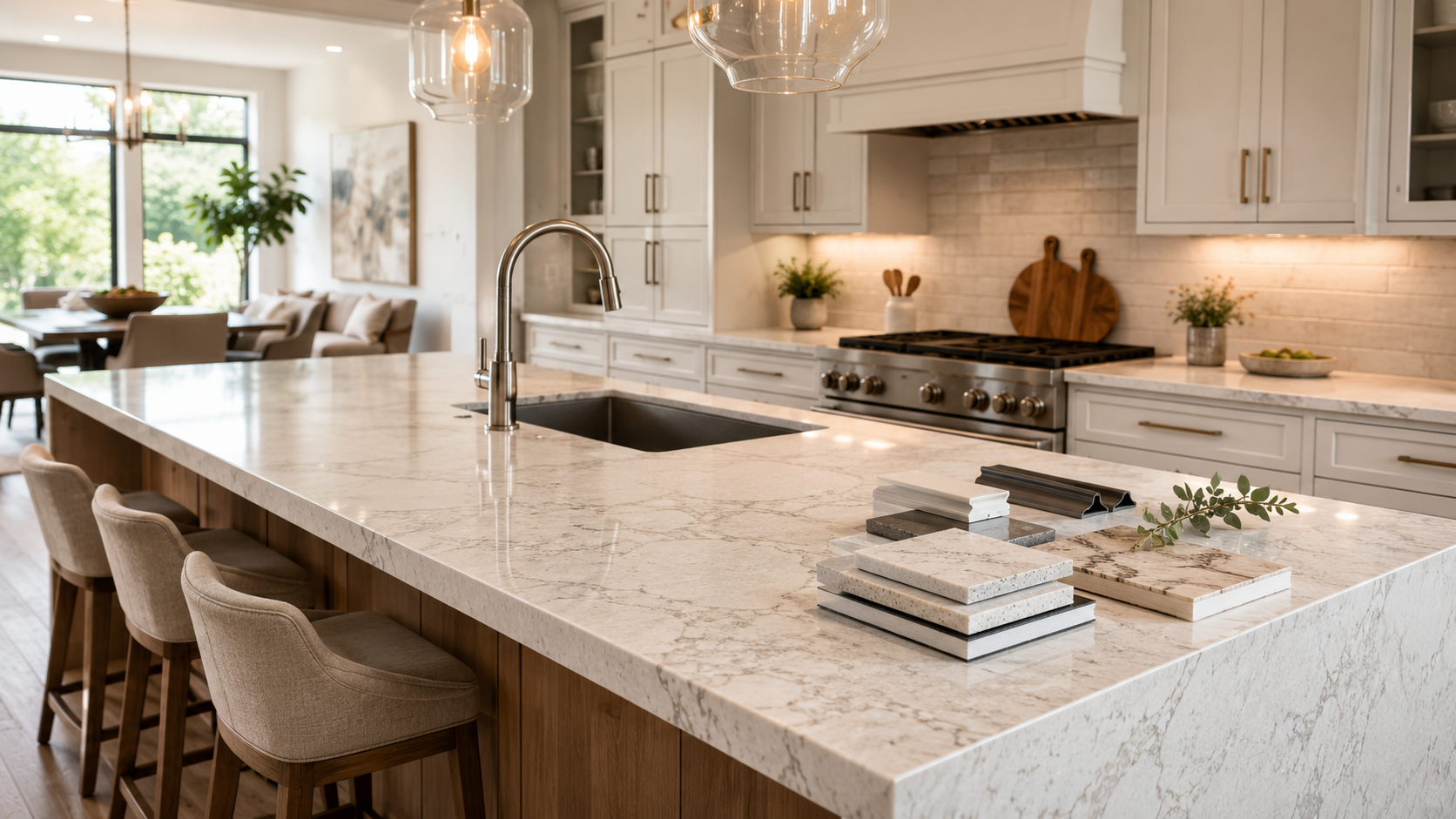
Best options: Engineered stone, granite, sealed concrete Consider: Waterfall edge (extends to floor) adds visual impact
💰 Countertop Costs and Budget Considerations
Countertop costs vary dramatically by material and complexity.
Cost Comparison (per linear foot installed):
Budget options:
- Laminate: $20-40 per linear foot
- Basic tile: $30-60 per linear foot
Mid-range options:
- Solid surface: $60-90 per linear foot
- Sealed concrete: $80-150 per linear foot
- Butcher block: $60-100 per linear foot
Premium options:
- Engineered stone (quartz): $100-200+ per linear foot
- Granite: $100-200+ per linear foot
- High-end marble: $150-300+ per linear foot
Installation and edge details add 30-50% to material cost
Hidden Costs:
- Edge treatment – Decorative edges cost more
- Seaming – Multiple pieces require professional seaming
- Sink installation – Undermount vs. drop-in affects cost
- Backsplash – Often done simultaneously
- Removal of old counters – Labor and disposal
- Substrate preparation – If cabinets need repair
🔧 Installation Considerations
Professional installation is critical for most countertops.
When DIY Is Possible:
- Laminate (relatively straightforward)
- Basic tile (if you have tile skills)
When Professional Installation Is Essential:
- Natural stone (requires seaming expertise)
- Engineered stone (precision seaming required)
- Solid surface (thermoforming, integrated sinks)
- Concrete (requires skilled finishing)
- Tile (grout quality depends on application)
Professional installation importance:
- Proper seaming prevents water infiltration
- Correct sealing protects surface
- Proper substrate preparation ensures longevity
- Warranty usually requires professional installation
🧼 Maintenance by Material Type
Different countertops require different ongoing care.
Low Maintenance (Easiest):
- Engineered stone (quartz): Wipe with mild soap and water
- Laminate: Wipe with damp cloth; avoid excessive water
- Solid surface: Wipe clean; avoid harsh chemicals
Moderate Maintenance:
- Sealed granite: Periodic sealing (1-3 years)
- Sealed concrete: Periodic sealing (annually or as needed)
- Sealed slate: Periodic sealing
High Maintenance (Requires Commitment):
- Marble: Frequent sealing, avoid acidic foods, requires care
- Butcher block: Regular oiling, avoid water, food prep required
- Unsealed concrete: Frequent sealing, stain protection
Maintenance cost consideration: Low-maintenance surfaces save money and stress over 20+ years
🎯 Making Your Countertop Decision: A Step-by-Step Process
Step 1: Identify Your Kitchen/Bathroom Use
- How much cooking happens?
- How many people use the space?
- What’s your lifestyle (busy family, entertaining, minimal use)?
- Are you willing to maintain surfaces?
Step 2: Prioritize What Matters
For each room, rank what’s most important (durability, appearance, maintenance, cost, sustainability).
Step 3: Research Materials Meeting Your Priorities
Based on your priorities, identify materials that align with your values.
Step 4: Visit Showrooms and See Real Samples
Pictures don’t convey true colors, finishes, or scale. Visit showrooms and see samples in your home’s lighting.
Step 5: Consider Your Design Aesthetic
Does the material support your kitchen’s design style? (Modern/contemporary, traditional, rustic, farmhouse, etc.)
Step 6: Evaluate Maintenance Commitment
Be realistic about maintenance. If you won’t seal counters annually, choose non-sealing material.
Step 7: Get Professional Estimates
Costs vary by complexity. Get quotes from 2-3 contractors for accurate pricing.
Step 8: Make Your Decision
Choose the material that best balances appearance, function, maintenance, and budget for your specific situation.
The Bottom Line: The Right Countertop for Your Life
There’s no universally “best” countertop. The best countertop for you is the one that:
- Performs well in your kitchen/bathroom
- Looks beautiful in your space
- Aligns with your lifestyle and maintenance willingness
- Fits your budget (both initial and long-term)
- Fits your values (durability, sustainability, etc.)
When you align countertop selection with your actual life and needs, you’ll be happy with your choice for decades.
At All-Pro Renovations, we help Kansas City homeowners navigate countertop decisions by understanding their specific needs and helping them balance form and function. We’ve installed every major countertop type and know which performs best in different situations.
Ready to Choose Your Perfect Countertops?
If you’re planning a renovation and need guidance on countertop selection, let’s talk about your kitchen or bathroom and your lifestyle.
Contact All-Pro Renovations today for your free consultation.
📞 Call us at 913-354-2380
📅 Schedule your free estimate online
💬 Email us at info@all-proserviceskc.com
We serve homeowners across Kansas City, Overland Park, Olathe, Lee’s Summit, Shawnee, Lenexa, and all surrounding communities.
FAQs About Countertop Selection
Q: What’s the most durable countertop material? A: Engineered stone (quartz) and granite are extremely durable. Engineered stone is harder and requires no sealing. Both last 25-50+ years.
Q: Which countertop requires the least maintenance? A: Engineered stone (quartz) is lowest maintenance — no sealing, just wipe clean. Laminate and solid surface are also very low maintenance.
Q: Can I use marble in a kitchen? A: You can, but it requires significant maintenance. Marble etches from acidic foods and stains easily. Better for secondary surfaces or light-use kitchens.
Q: How often does granite need sealing? A: Quality granite typically needs sealing every 1-3 years, depending on sealer quality and use. Some modern sealers last longer.
Q: What’s the most affordable countertop option? A: Laminate is most affordable (20-40 per linear foot installed). Tile and solid surface are budget-friendly mid-range options.
Q: Can scratches in engineered stone be repaired? A: Engineered stone cannot be easily repaired if damaged. Scratches are permanent. For easily repairable surfaces, choose solid surface or butcher block.
Q: Is concrete a good kitchen countertop choice? A: Concrete can work for kitchens. It’s heat-resistant and customizable, but requires sealing and maintenance. Best for design-focused kitchens.
Q: How important is backsplash when selecting countertops? A: Backsplash is separate but coordinated. Choose countertops first; backsplash should complement the countertop material and color.
All-Pro Renovations has been helping Kansas City homeowners select and install quality countertops since 2017. We know which materials perform best in our climate and kitchens. Let us guide you to the perfect countertops for your renovation.
Posted in Construction, Design, Exteriors, Kitchen & Bath, Property Investment, Remodeling