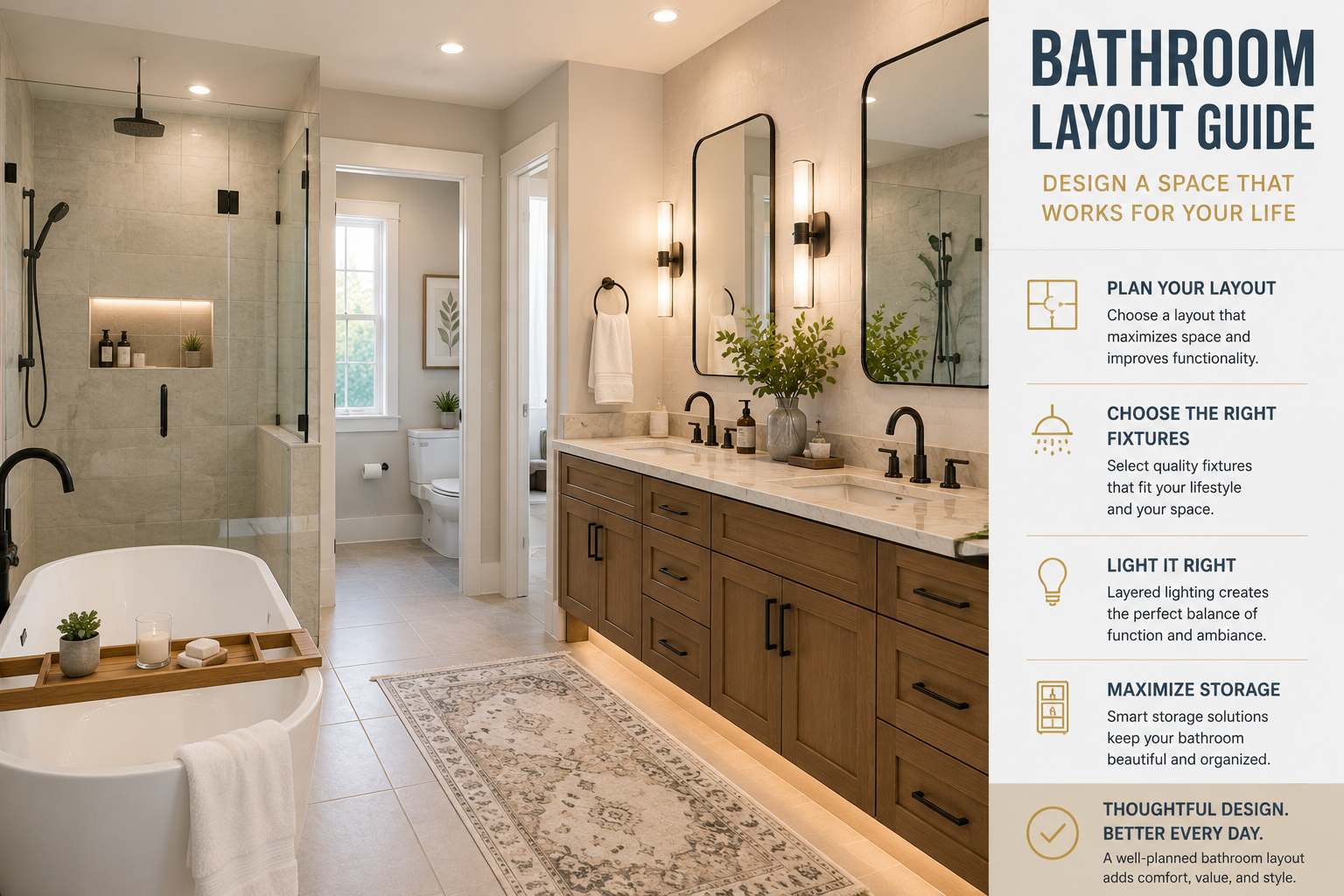
The Complete Guide to Creating Your Perfect Bathroom Space
Your bathroom is one of the most personal spaces in your home. It’s where you start your day, unwind after work, and prepare for what’s ahead. Yet many homeowners approach bathroom renovations without truly thinking through how the space should function for their lifestyle.
The difference between a bathroom that merely exists and one you absolutely love often comes down to one critical factor: layout.
At All-Pro Renovations, we’ve remodeled hundreds of bathrooms across Kansas City, Overland Park, Olathe, Lee’s Summit, and the surrounding metro area. We’ve learned that the most successful bathroom renovations start with understanding how you actually use the space — and then designing a layout that supports that lifestyle.
In this comprehensive guide, we’ll walk you through everything you need to know about bathroom layouts, from understanding different configurations to selecting fixtures that work together seamlessly.
Why Bathroom Layout Matters More Than You Think
Before you select a single tile or fixture, understand this: layout determines functionality.
A poorly designed layout can create these frustrating scenarios:
- Traffic conflicts – Multiple people can’t use the bathroom at the same time without bumping into each other
- Poor lighting – The vanity is in shadow, making grooming difficult
- Wasted space – The room feels cramped even though it has adequate square footage
- Awkward fixture placement – The toilet is visible from the doorway; the shower drains to the wrong location
- Limited storage – No logical place for towels, toiletries, or cleaning supplies
- Inefficient workflow – You have to navigate around obstacles to reach what you need
The right layout prevents all of these problems. It maximizes usable space, improves functionality, supports multiple users, and creates a bathroom you genuinely enjoy spending time in.
🎯 Understanding the Three Main Bathroom Layouts
The Galley Layout (Linear Setup)
The galley bathroom features fixtures arranged along two parallel walls, creating a linear flow through the space.
Best for: Smaller bathrooms, narrow spaces, guest bathrooms
How it works: Typically you enter the bathroom and see a clear pathway down the center, with the vanity on one side and the toilet/shower on the other side.
Advantages:
- Makes efficient use of limited square footage
- Clear, organized flow
- Works well in smaller homes or apartments
- Easier to fit additional features without feeling crowded
Challenges:
- Can feel cramped if fixtures are too close
- Limited counter space in compact versions
- May not work well if you share the bathroom with another person
Tips for Success: In a galley layout, maximize vertical space with tall cabinets and shelving. Choose fixtures that don’t protrude far into the walkway. Consider vessel sinks or wall-mounted vanities to create visual openness.
The L-Shaped Layout
The L-shaped bathroom arranges fixtures along two perpendicular walls, creating a corner configuration.
Best for: Medium-sized bathrooms, master bathrooms, bathrooms that need to serve multiple users
How it works: Imagine the letter “L” — fixtures occupy two walls that meet at a right angle, leaving the other two walls partially open.
Advantages:
- Better use of space than galley layouts
- Creates natural zones (wet zone with shower/tub, dry zone with vanity)
- Works well for master bathrooms
- Can accommodate multiple users more comfortably
- Allows for larger vanities or double vanities
Challenges:
- Requires adequate square footage to feel proportional
- May waste corner space if not planned carefully
- Lighting needs careful consideration to avoid shadowy corners
Tips for Success: Use corner fixtures strategically — corner sinks or toilets can maximize space. Install lighting in multiple locations to eliminate shadows. Consider a corner shower to open up other wall space for a larger vanity.
The Walk-Through or Open Layout
This layout opens one side completely, often with fixtures arranged to maximize openness and flow.
Best for: Larger bathrooms, spa-like retreats, master bathrooms, families who value comfort
How it works: Rather than using walls for all fixtures, this layout spreads fixtures throughout the space, often creating zones for different activities (grooming, bathing, toilet).
Advantages:
- Feels spacious and luxurious
- Allows for larger fixtures (soaking tubs, large showers)
- Accommodates multiple users without feeling cramped
- Creates opportunity for design features like accent walls or statement lighting
- Supports separate water closets or wet rooms
Challenges:
- Requires significant square footage
- Uses more materials and has higher renovation costs
- Privacy considerations if multiple doorways exist
- Requires careful planning to avoid wasted space
Tips for Success: Define distinct zones even though the space is open. Use flooring changes, lighting, or subtle design elements to create visual separation. Ensure adequate privacy for toilet areas even in open designs.
📐 Essential Measurements and Spacing Guidelines
Proper spacing is critical for a functional bathroom. Here are the guidelines that create comfortable, accessible bathrooms in Kansas City homes:
Vanity and Sink Clearance
- Minimum depth: 20 inches from vanity to opposite wall
- Ideal depth: 24-30 inches for comfortable grooming
- Counter space: Minimum 36 inches width; ideally 48+ inches for a comfortable workspace
- Height: Standard 32-36 inches; wheelchair accessible is 34 inches
- Spacing from toilet: Minimum 6 inches to either side
Toilet Clearance
- Distance from wall: 12 inches to center of toilet
- Space on either side: Minimum 15 inches from toilet center to any fixture or wall
- Clearance in front: Minimum 21 inches from wall to any obstacle
- Centered in alcove: Looks intentional and uses space efficiently
Shower and Tub Clearance
- Shower minimum size: 32 x 32 inches (though 36 x 36 inches is more comfortable)
- Tub surround minimum: 36 inches on the side you enter from
- Distance from other fixtures: Minimum 12-18 inches from vanity, toilet, or other fixtures
- Door swing: Must clear fixtures and walls when fully opened
Doorway and Traffic Flow
- Door width: Standard 32 inches; ideally 36 inches for accessibility
- Clear floor space at entry: Minimum 24 x 32 inches of open flooring
- Main traffic path: Minimum 30 inches wide, ideally 36-42 inches
- Path to fixtures: No sharp angles that create obstacles
These measurements might seem technical, but they directly impact how comfortable and functional your bathroom feels. A bathroom that meets these guidelines will feel spacious and easy to navigate. One that doesn’t will constantly feel cramped.
🚿 Choosing Your Fixtures: Wet Zone vs. Dry Zone
Successful bathroom layouts separate the wet zone (shower and tub) from the dry zone (toilet and vanity).
The Wet Zone: Shower and Tub
Single Shower Configuration
- Best for: Smaller bathrooms, guest baths, master baths where space is limited
- Space required: Minimum 32 x 32 inches; ideally 36 x 48 inches or larger
- Advantages: Efficient use of space, easier to maintain water management
- Considerations: A single shower may not work for families or couples
Combination Shower-Tub
- Best for: Family bathrooms, master baths, accommodating multiple preferences
- Space required: Minimum 5 feet wide by 3 feet deep
- Advantages: Flexibility for different bathing needs, appeals to wider range of buyers
- Considerations: Takes up significant space, requires careful ventilation planning
Freestanding Tub + Separate Shower
- Best for: Luxury master baths, larger bathrooms, spa-inspired designs
- Space required: Requires 50+ square feet to feel balanced
- Advantages: Creates distinct spa-like zones, very visually appealing, accommodates two people
- Considerations: Requires significant space; may not be practical in smaller bathrooms
Walk-In Shower (No Tub)
- Best for: Master bathrooms, aging-in-place designs, modern minimalist aesthetics
- Space required: Minimum 36 x 36 inches; ideally 48 x 60 inches for luxury
- Advantages: Accessibility, contemporary look, easier to clean than tubs
- Considerations: Families may miss having a tub for children
The Dry Zone: Toilet and Vanity
Single Vanity
- Best for: Smaller bathrooms, guest bathrooms, secondary baths
- Counter width: Minimum 24 inches; ideally 36-48 inches
- Advantages: Efficient use of space, straightforward design
- Considerations: Shared bathrooms may create bottlenecks during morning routines
Double Vanity
- Best for: Master bathrooms, family bathrooms, homes with multiple users
- Counter width: Minimum 60 inches; ideally 72-96 inches
- Advantages: Accommodates multiple users, increases storage and counter space
- Considerations: Requires significant wall space; may not fit in smaller bathrooms
Vessel Sinks
- Best for: Modern or contemporary bathrooms, spaces where you want visual lightness
- Advantages: Contemporary aesthetic, creates visual interest, saves vanity depth
- Considerations: Less counter space; splashing is more likely with pedestal versions
Wall-Mounted Vanities
- Best for: Small bathrooms, contemporary designs, creating floor space visibility
- Advantages: Makes floor feel more open, easier to clean underneath
- Considerations: Requires structural support; offers less storage than cabinet vanities
Toilet Placement
- Conventional: In a corner or opposite the door, creating privacy and using wall space efficiently
- Separate water closet: In its own small room or enclosed space; ideal for master baths with multiple users
- Alcove placement: In an indented space that feels intentional rather than cramped
💡 Lighting Design for Functional Bathrooms
Poor lighting is one of the most common complaints about bathroom layouts. Here’s how to get it right:
Task Lighting (Around the Vanity)
This is the most important layer. You need clear, shadow-free light for grooming.
- Fixtures: Sconces on either side of the mirror (ideal), or fixtures above the mirror
- Color temperature: Daylight balanced (4000-5000K) for most accurate color representation
- Positioning: Mount sconces at eye level, about 36-40 inches apart
- Dimmer switch: Allows you to adjust brightness for different times of day
Ambient Lighting (General Illumination)
This provides overall light to the space.
- Fixtures: Ceiling-mounted lights, recessed lights, or a combination
- Placement: Position ceiling lights to avoid creating shadows in corners
- Multiple sources: Use at least two separate light sources so you’re not dependent on one
Accent Lighting (Design Feature)
This highlights architectural or design elements.
- Fixtures: Niche lighting, under-cabinet lighting, or backlit mirrors
- Purpose: Creates visual interest and makes the space feel intentional
- Dimmer: Great for creating ambiance while bathing
Kansas City Climate Consideration
Our climate means your bathroom gets used year-round for completely different purposes. Winter mornings require bright, energizing light. Summer evenings require softer mood lighting. A well-lit bathroom in Kansas City should have dimmer controls on all layers so you can adapt to seasonal and time-of-day needs.
🔄 Traffic Flow and Accessibility
The best bathroom layouts allow people to move through the space without obstacles or awkward collisions.
Single-User Bathrooms
Prioritize a clear path from door to each fixture. Avoid placing the toilet directly visible from the doorway if possible — position it around a corner or use a half-wall for privacy.
Shared Bathrooms
Create zones that allow simultaneous use when possible. A double vanity with its own lighting allows someone to groom while another person uses the toilet (with privacy screening). This dramatically improves functionality for families or couples.
Aging-in-Place Considerations
If you’re planning a bathroom for long-term use, accessibility is critical:
- No threshold: Level floor at doorway
- Grab bar reinforcement: Built into walls during framing
- Roll-in shower: 36 x 60 inches minimum, no curb
- Wider doorways: 36+ inches to accommodate mobility aids
- Open floor space: Clear turning radius of 60 inches minimum
These features don’t make a bathroom look medical — modern accessible bathrooms are beautiful and function better for everyone, not just people with mobility limitations.
📏 Common Bathroom Size Scenarios
Small Bathrooms (Less Than 40 Square Feet)
- Ideal layout: Galley or linear
- Recommended fixtures: Single vanity, shower-tub combination, toilet
- Space-saving tips: Wall-mounted vanity, compact toilet, corner shelving
- Focus: Maximum efficiency; every inch counts
Standard Bathrooms (40-60 Square Feet)
- Ideal layout: L-shaped or galley with room to breathe
- Recommended fixtures: Single or compact double vanity, separate shower and tub (or large shower), standard toilet
- Space-saving tips: Efficient layout, thoughtful storage, good lighting
- Focus: Balanced functionality and comfort
Large Master Bathrooms (60-100+ Square Feet)
- Ideal layout: Open layout with distinct zones
- Recommended fixtures: Double vanity, separate shower and freestanding tub, potentially separate water closet
- Features: Heated floors, ambient lighting, accent pieces
- Focus: Luxury and relaxation; creating a spa-like retreat
🎨 Design Coordination with Layout
Your layout influences your design choices:
Galley layouts benefit from light colors and simple fixtures to avoid visual clutter.
L-shaped layouts can accommodate a bit more visual complexity; you have more wall space for accent features.
Open layouts are where you can really express design personality — large tile patterns, statement lighting, unique finishes. The open space can carry more visual interest.
Kansas City Design Note: Our market values timeless design over trends. A well-executed bathroom layout in neutral colors and classic finishes will appeal to far more buyers than a trendy layout that may feel dated in five years.
🔧 Common Layout Mistakes to Avoid
Placing the Toilet Opposite the Door
Unless your bathroom is large enough to feel intentional, a toilet in direct view from the entry feels awkward. Position it around a corner or alcove when possible.
Undersizing the Shower
A shower that’s too small feels cramped and limits your ability to update it later. Minimum should be 32 x 32 inches; ideally aim for 36 x 48 inches or larger if your space allows.
Double Vanity That’s Too Wide
While double vanities are great, one that’s too wide can make the bathroom feel like a hallway. Aim for proportion — typically 60-72 inches is the sweet spot for a balanced look.
Poor Ventilation Planning
Bathroom moisture needs to escape. Place exhaust fans near the shower/tub and run ducting to the exterior (not the attic). A poorly ventilated layout leads to mold and moisture problems regardless of how beautiful it looks.
Insufficient Counter Space
Every centimeter of counter space gets used. Cramped counters lead to clutter and frustration. Prioritize adequate counter depth and width, even if it means using a smaller vanity style.
One Light Source
A single ceiling fixture creates shadows and feels harsh. Layer your lighting with sconces, ceiling lights, and task lighting for a space that’s both functional and attractive.
🏡 Creating Your Ideal Layout: A Step-by-Step Process
1. Assess Your Current Space
Measure your bathroom precisely. Note door swings, window locations, plumbing locations, and any structural limitations.
2. Identify Your Priorities
What matters most to you?
- Spa-like luxury?
- Efficient morning routines?
- Accommodating multiple users?
- Accessibility for aging in place?
- Storage and organization?
Your priorities should drive your layout decisions.
3. Consider Your Lifestyle
How do you actually use your bathroom?
- Quick morning showers or long baths?
- Shared with a partner or children?
- Space for a makeup vanity or grooming routine?
- Storage needs for products and towels?
The layout should support your actual life, not someone else’s ideal bathroom.
4. Consult with a Professional
A designer or experienced contractor can help you optimize your specific space. At All-Pro Renovations, our design team creates detailed layouts that maximize functionality while fitting your vision and space constraints. We use CAD drawings so you can see exactly how the layout will function before construction begins.
5. Test the Layout
Before committing to a design, imagine yourself in the space. Walk through the daily routine. Does the layout support your needs? Are fixtures positioned logically? Is there adequate storage? Is lighting positioned where you need it?
6. Build in Flexibility
Design fixtures and storage in ways that allow future changes. A well-designed bathroom should work for you now and be flexible enough to adapt as your needs change.
✨ The Impact of Layout on Your Home’s Value
A well-designed bathroom layout matters when it comes time to sell. Buyers notice:
- Logical flow – A bathroom that makes sense feels move-in ready
- Multiple-user functionality – Double vanities and adequate space appeal to families
- Accessible design – Grab bars and open layouts appeal to aging homeowners
- Appropriate sizing – A bathroom that feels spacious without being wasteful
- Quality fixture placement – Expensive fixtures positioned poorly create frustration
An excellent bathroom layout often contributes significantly more to perceived value than expensive fixtures in a poorly configured space.
The Bottom Line: Layout First, Fixtures Second
Many homeowners start by selecting beautiful tiles, fixtures, and finishes — then try to force them into an existing layout. The better approach is to design the layout first, then select fixtures and finishes that work with that layout.
A bathroom with a thoughtful, well-executed layout will serve you beautifully for decades. Even simple finishes feel sophisticated when they’re positioned logically and support your lifestyle.
At All-Pro Renovations, we’ve designed hundreds of bathroom layouts across Kansas City — from tiny powder rooms to luxurious master bath suites. We know how to maximize your space, support your lifestyle, and create a bathroom you’ll genuinely love using every single day.
Ready to Design Your Perfect Bathroom?
If you’re planning a bathroom renovation in the Kansas City area, let’s start with the layout. Our design team will work with you to create a space that’s beautiful, functional, and perfectly suited to how you actually live.
Contact All-Pro Renovations today for your free consultation.
📞 Call us at 913-354-2380
📅 Schedule your free estimate online
💬 Email us at info@all-proserviceskc.com
We serve homeowners across Kansas City, Overland Park, Olathe, Lee’s Summit, Shawnee, Lenexa, and all surrounding communities in Johnson, Wyandotte, and Jackson counties.
FAQs About Bathroom Layouts
Q: What’s the ideal size for a master bathroom? A: Master bathrooms typically work best between 60-100 square feet. This allows for separate shower and tub, double vanity, and comfortable spacing around each fixture. Smaller can work with good planning; larger allows for luxury features like freestanding tubs and larger showers.
Q: Can I fit a double vanity in a small bathroom? A: It depends on the layout. A compact double vanity (60 inches) can fit in many smaller bathrooms, but may make the space feel cramped. A single vanity with good storage often functions better in very small spaces. Our design team can evaluate your specific situation.
Q: What’s the minimum size for a walk-in shower? A: Technically 32 x 32 inches, but most people find this cramped. Aim for at least 36 x 36 inches if possible. Larger showers (48 x 60 inches+) feel luxurious and are easier to clean. Consider your space and budget when deciding.
Q: Should the toilet be visible from the bathroom door? A: Not ideally. If possible, position the toilet around a corner or use a partial wall for privacy. However, in very small bathrooms, this may not be possible. In those cases, focus on making the toilet feel intentional rather than awkward.
Q: How important is ventilation in bathroom layout? A: Very important. Poor ventilation leads to moisture problems, mold, and mildew regardless of how beautiful your finishes are. Your layout should include a properly positioned exhaust fan with ducting to the exterior.
Q: Can I put a freestanding tub in a small bathroom? A: Technically yes, but it needs careful planning. A small freestanding tub in a tiny bathroom can look odd and limit other functions. Generally, freestanding tubs work best in bathrooms over 60 square feet.
Q: What if I don’t know what layout would work in my space? A: That’s exactly what our design team is for. We’ll measure your space, understand your lifestyle, and create several layout options for you to choose from. Many homeowners are surprised by the possibilities once a professional evaluates their space.
All-Pro Renovations has been transforming Kansas City bathrooms since 2017. We combine functional design with beautiful finishes to create bathrooms you’ll love. Contact us today to start designing your perfect space.
Posted in Construction, Design, Exteriors, Kitchen & Bath, Property Investment, Remodeling